API Security: The Six Gates
by allencharp
Where to Start
There is no single answer to “how do I secure this API” — the right set of controls depends entirely on what the API does and who can reach it. Three questions settle it:
- Who calls it — first-party browser, mobile app, server-to-server, or a third party?
- What does it touch — public catalogue data, or payments and PII?
- Where does it sit — public internet, or inside a service mesh?
Those answers decide how much of what follows is worth building, and in what depth. The rest of this note walks a single request from the socket to the database, describing one control per hop — an ordering that keeps a security review from collapsing into an unordered list of vulnerabilities.
Six Gates
Every request crosses the same six boundaries. Each one answers a single question, and none of them substitutes for another.
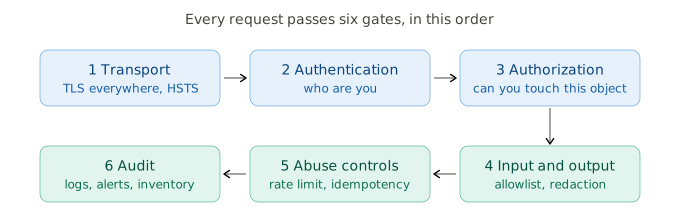
1. Transport. TLS on every hop, including the internal ones — “it is behind the VPN” stops being true the day someone adds a second ingress. HSTS, no silent downgrade, and mTLS between services inside the mesh.
2. Authentication — who are you. For users, OAuth 2.1 / OIDC with short-lived access tokens and rotating refresh tokens. For services, mTLS or signed assertions; an API key alone carries no identity and no proof of possession. Secrets live in a KMS or secrets manager, never in the repo, never in an image layer.
3. Authorization — may you touch this object. One layer below, and the one that actually gets breached. See the next section.
4. Input and output. Schema validation on an allowlist, not a denylist. Parameterised queries. Mass-assignment protection — a client that can PUT {"role":"admin"} will. Response redaction, and error bodies that carry a code rather than a stack trace.
5. Abuse controls. Rate limits keyed on user, key and endpoint together — IP alone is useless against a distributed client and punishes everyone behind a NAT. Brute-force lockout with backoff on login and OTP endpoints. Idempotency-Key on anything that moves money. Signature plus nonce plus timestamp window if replay matters.
6. Audit. An accurate API inventory, because you cannot secure an endpoint you forgot existed. Shadow and zombie APIs retired on a schedule. Authn, rate limiting and access logs centralised at the gateway, with alerting on anomalous call patterns.
Layer Three Is Where Breaches Happen
Most real API breaches aren’t crypto failures — they’re requests that authenticated fine, then touched data they shouldn’t. The fix is one line of server-side ownership code that keeps getting skipped, because middleware auth feels like it covered this.
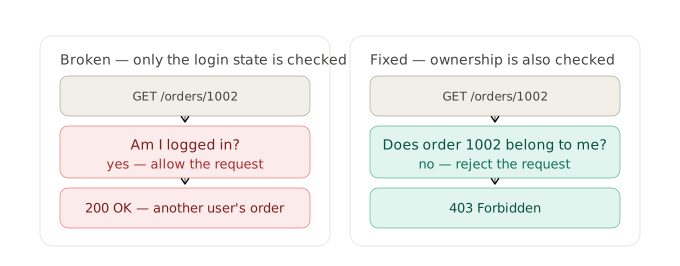
The 2023 OWASP API Security Top 10, reduced to the actual fix:
| Risk | The actual fix |
|---|---|
| BOLA — object level | Ownership check on every request for every object id |
| Broken authentication | Short tokens, rotation, one-time codes |
| BOPLA — property level | Allowlist writable fields; never return internal fields |
| Unrestricted resource consumption | Depth/complexity/pagination caps, timeouts |
| BFLA — function level | Enforce roles server-side on every admin and write route |
| Sensitive business flows | Rate limit the flow, not the endpoint |
| SSRF | Allowlist outbound destinations; block link-local metadata |
| Misconfiguration | No directory listing, verbose errors, default creds |
| Improper inventory | Retire old versions; document every route |
| Unsafe consumption | Validate third-party API responses too |
Scanners miss business logic. Never trust amounts, stock, or coupon state from the client — the server decides what they’re worth. Lock concurrency; validate state machines on every transition.
tags: api-security - security-design